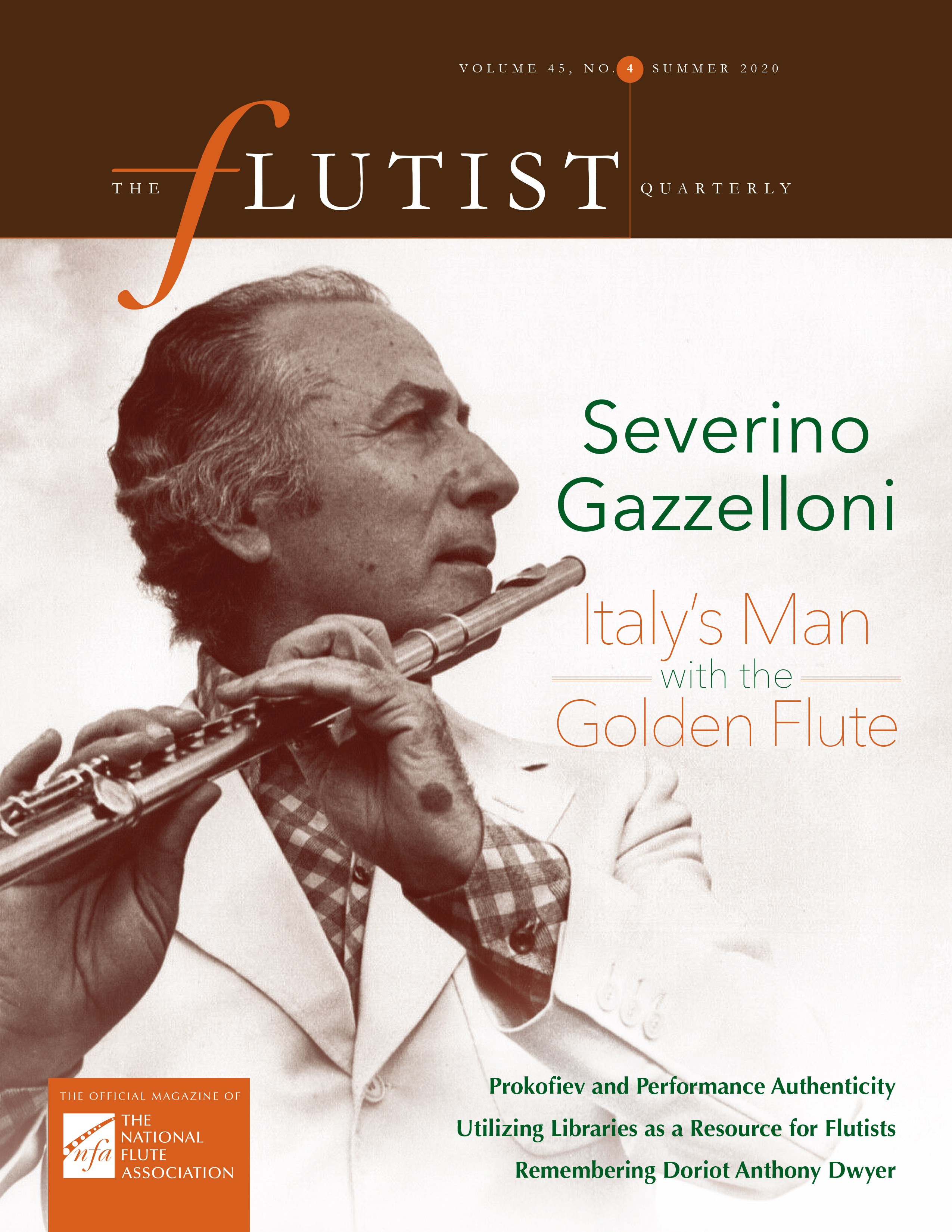
The Flutist Quarterly

Summer 2010 Issue Cover

The Winter 2012 Issue

Forty years of artistry and vision are recalled in this special issue of The Flutist Quarterly. Discover how the NFA began, the people and events that fueled its development, and how it has grown since its inception in 1973. A comprehensive article describing every one of the NFA’s 70 commissions; insights by committee chairs and former presidents; and lively descriptions of the annual conventions that comprise the heart and soul of the organization are included. Learn the whereabouts of past competitions winners—and watch for more sightings in future issues of The Flutist Quarterly throughout this Ruby Anniversary year. Find information on the 2012 convention in Las Vegas—poised to propel the NFA into its next 40 years.


Features from this Issue


Silver to Rubies: The First 25 Years

by Anne Welsbacher

Chapter One‹in which the National Flute Association is born, makes friends, and falls in love‹ begins in 1973 and concludes in 1997. Subsequent chapters transpire on the following pages of this Ruby Anniversary issue celebrating 40 years of the NFA.

Looking Back: 1998 to 2000

by Gwen Powell, Patti Adams, Eric Hoover, Amy Porter, Angeleita Floyd, and George Pope

The Silver Anniversary year capped a stunning first quarter-century for the NFA, from 1972 to 1997. The Jubilation convention of ¹97 offers a silver portal into the 15 years featured in this Ruby issue. Former presidents and program chairs describe the NFA of 1998 to 2000 and its conventions in Phoenix, Atlanta, and Columbus.

Committees: Running the Machine

by Lori Akins, Dolores August, Aldo Baerton, Laura Barron, Karl Barton, Gaile Griffore, Rebecca Hovan, Bernard Phillips, Christine Potter, Irene Pruzan, Ali Ryerson, Lisa Garner Santa, Diane Boyd Schultz, John Solum, Stacey Steele, Michael Stoune, Rae Terpenning, Michael R. Treister, Anne Welsbacher, Peter Westbrook, and Amy Zuback

A large cog in the NFA¹s high-turbine engine is its massive collection of committees and appointments, which do everything from planning a convention featuring thousands of people and hundreds of events to proofreading a publication. Coverage of committees continues on pages 50, 62, and 91.

Remembering Myrna Brown, David Hart, and Frances Blaisdell


Among giving opportunities are three funds set up to honor people who were important in the lives of NFA members and the organization itself. Who were they? Read on.

A New Millennium: 2001 to 2003

by Kyril Magg, John Bailey, George Pope, and Alexa Still

The new century¹s conventions featured pedagogy, honored the maturing organization¹s legacy in a period when the NFA joined the nation in mourning, and entered into a new era of risk and hope. Former presidents and program chairs describe the NFA of 2001 to 2003 and its conventions in Dallas, Washington, D.C., and Las Vegas.

Growing Communications

by Anne Welsbacher

The first decade of the new century ushers in new communications staff and offerings.

Moving Forward: 2004 to 2006

by John Bailey, Stephanie Jutt, Sue Ann Kahn, Kyle Dzapo, Katherine Borst Jones, and Thomas Robertello

Increased professionalism and expanded programs are among the achievements in this period of growth. Former presidents and program chairs describe the NFA of 2004 to 2006 and its conventions in Nashville, San Diego, and Pittsburgh.

Collaborations: 2007 to 2009

by Alexa Still, Nancy Andrew, Patti Adams, Jonathan Keeble, Leonard Garrison, and Linda Toote

An era of austerity in the face of a national recession challenges the NFA to find creative ways to continue its trademark excellence in program offerings while ensuring long-term organizational health. The decade ends with the NFA on solid financial footing and ready to move forward. Former presidents and program chairs describe the NFA of 2007 to 2009 and its conventions in Albuquerque, Kansas City, and New York.

Looking Ahead: 2010 to 2012

by Anne Welsbacher, Cynthia Ellis, Lisa Garner Santa, and Zart Dombourian-Eby

A revamped website, streamlined new mission, and more sophisticated procedures for everything from fundraising to applying for competitions drives the NFA into a vibrant new era as it faces its fifth decade inspiring flutists and enriching lives. Former and current program chairs describe the NFA conventions of 2010 to 2012 in Anaheim, Charlotte, and Las Vegas.

Frequently Asked Questions

When will I receive my first Flutist Quarterly?
The first Flutist Quarterly is scheduled to be printed by the fall of each year. Your membership year begins August 1. If you join at a later date, you will be sent back issues of the Flutist Quarterly, plus any other mailings you may have missed.
How do I change my mailing address?
You can Sign In to your NFA account and make the change or alternatively, contact the NFA Office. Bulk rate mail is not forwarded. The NFA will be responsible for one missed magazine in the event an address change crosses in the mail. Missed issues due to bad addresses are available at the back issue rate of $10 per copy for members. Non-members may purchase back issues at the rate of $12 each.
Am I able to purchase back issues of the Flutist Quarterly?
Yes; they are available through the NFA Store for $10.00 per issue, plus shipping.
I am having difficulty opening the Flutist Quarterly file downloaded from the NFA web site. What should I do?
The Flutist Quarterly is saved in the standard .PDF format. This format requires the free Adobe Reader software, available directly from Adobe at. You may in fact already have Adobe Reader installed on your computer, although we recommend downloading and installing the latest version from Adobe if you do not already have it.


For nearly four decades, The Flutist Quarterly has provided NFA members information about and insights into the performance, study, history, manufacture, and enjoyment of flutes, flutists, and flute music. Published four times per year, it features articles written by leading flute performers, scholars, and teachers and news about developments and accomplishments in the NFA membership as well as the flute community at large.